

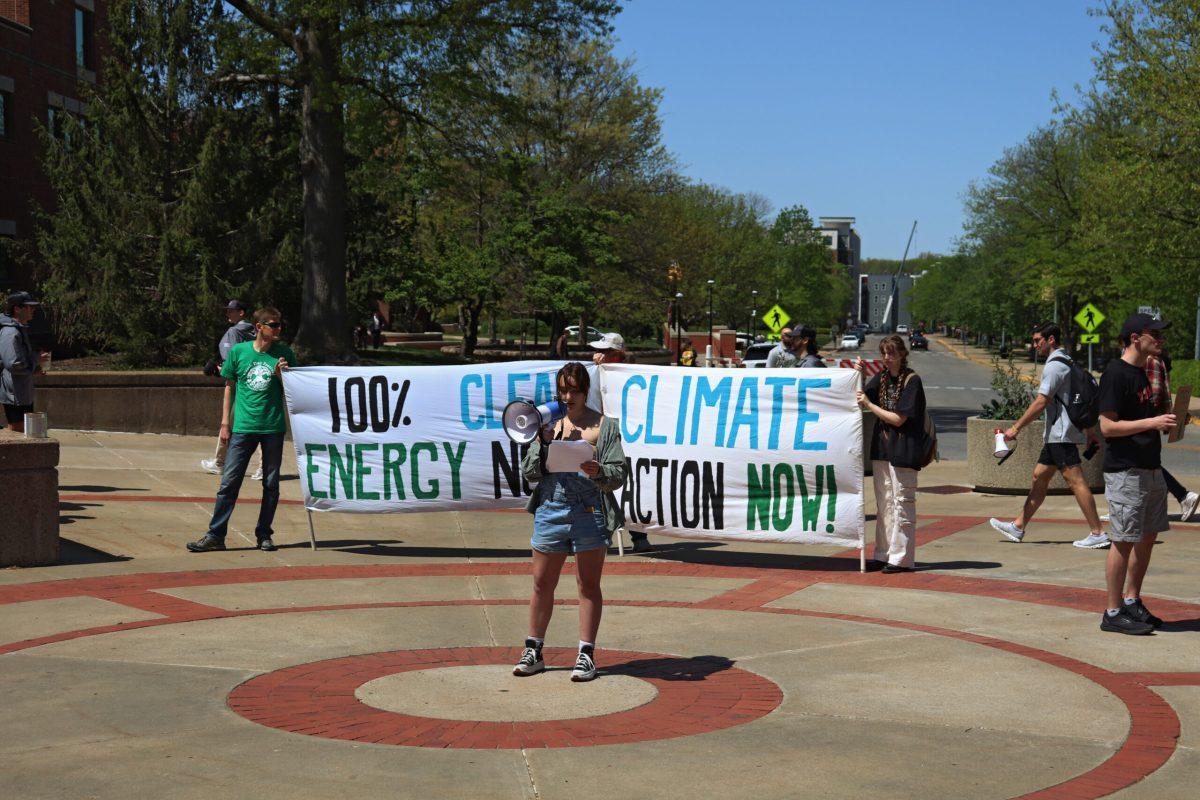
Climate Leaders at Mizzou organized a climate strike in Speakers Circle, advocating for transparency and urging MU to move its investments out of the fossil fuel industry.
Climate Leaders at Mizzou, a student organization dedicated to environmental conservation, held a climate strike for divestment in Speakers Circle from noon to 2 p.m. on Friday. Divesting from fossil fuels involves moving money and investments out of the fossil fuel industry to demonstrate a commitment to sustainable finance practices.
CLAM was joined by speakers from the MU Chapter of the Young Democratic Socialists of America, Medical Students for a Sustainable Future, Peaceworks, League of Women Voters and the Sierra Club.
The organizers of the strike gave three demands for MU: fully divest and “freeze any new investments in the 200 largest publicly traded fossil fuel companies” within five years, “commit to transparency about the university’s endowment investments” and “create a Responsible Investments Committee” including undergraduates, graduates and faculty to guide the university’s future investments.
Traditional energy sources include fossil fuels like petroleum and coal, which are nonrenewable energy sources. Renewable and sustainable energy sources include solar and wind power and are usually less harmful to the environment to harness.
According to MU News Bureau Director Christian Basi, MU currently has about $10 million invested in companies that invest in some traditional energy technologies. Basi noted that these companies may not exclusively invest in traditional energy and may also invest in renewable energy. Basi also said the university has about $11 million invested in companies that invest in renewable and sustainable energy. According to Basi, these combined investments account for approximately 1% of MU’s total investments.
Ella Reichard, MU junior and CLAM Vice President, grew up learning about the connection between humans and nature from her grandmother, a conservation agent and herbalist. After taking an activism class, Reichard was inspired to get this divestment campaign up and running. CLAM is looking to obtain around 500 signatures for its divestment petition.
“A lot of universities have divested already and it’s kind of pushing other universities to follow,” Reichard said. “It’s not just about divesting from the university, but divesting as a whole.”
The climate strike began with a rally at noon. Students lined the steps of Speakers Circle, holding signs reading “Climate action now,” “100% clean energy now,” “Renewable is doable” and “Stop burning my future.” Speakers stood in the center of Speakers Circle, addressing the crowd with a bullhorn.
The Sierra Club, a grassroots environmental organization, set up a table at the strike. Carolyn Amparan, the organization’s executive committee chair, spoke at the rally.
“Right now, our country, and the world, is still investing in fossil fuel infrastructure,” Amparan said. “In order to stop that, we have to stop giving companies money to build fossil fuel infrastructure. One of the ways to do that is not reward them by buying their stock … that’s how divestment works. It sends a clear message that we don’t want fossil fuel infrastructure, either new or old.”
Basi said another important aspect to consider, along with investments, is what MU has done for its own carbon footprint.
“Since 2006, we have cut our coal consumption by 97%,” Basi said. “Coal is now down to less than 5% of the fuel that we use. We use much more sustainable cleaner fuels. Forty percent of the fuel comes from biomass, solar or wind power.”
According to Basi, many traditional energy companies have millions of dollars invested in renewable energies, so divesting from these companies could remove some money going toward sustainable technologies. Basi also said MU invests in energy markets, not individual companies, so it is difficult to know which specific companies the university is investing in as they can change on a regular basis.
“It’s not a simple cut and dry situation,” Basi said. “We feel like we’re being very responsible with the money that we have been entrusted with, as well as making sure that we are doing the best to reduce our own carbon footprint.”
During the rally, MU YDSA member Logan Carter led several chants.
“There’s no planet B,” Carter said. “We believe that, by divesting from fossil fuels, we can help to have a better planet, but also do it in a way that is local and impactful.”
MU sophomore Emma Borage attended the climate strike and decided to speak at the rally during the open mic.
“Climate change is something that I’ve been passionate about for a long time,” Borage said. “It’s an issue that affects everyone, and it’s an issue that’s not going to end.”
The strike also attracted members of the Columbia community, such as December Harmon, who is running for U.S. Senate in 2024.
“I believe that we failed to do everything we could to try to set up a better future,” Harmon said. “I want to do everything in my power to try to fix that.”
A march for divestment started about an hour and a half after the rally began. Chants echoed along the streets as a group of about 20 people circled the Student Center, marched past Memorial Union and walked around Jesse Hall before ending in Speakers Circle.
“We’re already experiencing the impacts of climate change,” Amparan said. “The best antidote for being anxious about the future and what might happen is to take action.”
Edited by Annie Goldman | [email protected]
Copy edited by Mary Philip