



Last year, the Columbia City Council approved a pair of ordinances requiring the Columbia Police Department to adopt transparency measures for police use of surveillance devices and greenlit the installation of Flock Safety automated license plate readers and cameras in Columbia.
After reviewing how the department uses Flock Safety devices, The Maneater found consistent failure of officers to follow the transparency policy enacted earlier this year.
This article is the first in a series reviewing the Columbia police’s use of surveillance technologies and authorization of external authorities to access data captured by Flock Safety technology in the city.
On Oct. 7, 2024, the Columbia City Council met in a regular council meeting with then Flock Safety public affairs manager Jonathan Paz, before approving the adoption of Flock surveillance devices. Paz assured concerned citizens of “accountability mechanisms embedded in the system, unlike other competitors in the industry.”
Included in these accountability mechanisms were a public transparency portal organizing data captured by Flock devices and random internal audits of officers’ utilization of data. The audits are available on the Columbia Police Department’s official website.
“No one can just go into the system and fool around,” Paz said. “You will be held accountable.”
Effective this March, Policy 460 enacted accountability standards for the use of Columbia’s automated license plate readers and fixed camera sites. This policy includes the maintenance of a transparency portal, which is supposed to display and catalog the locations of fixed camera sites operated by the police and the beats and wards of Flock automated license plate readers.
In the last 30 days, over 850,000 vehicles’ license plates and models were detected by Columbia’s 85 operating Flock devices and stored for potential use in investigations, according to the Columbia Police’s Transparency Portal. Officers searched this data 316 times over the same time period.
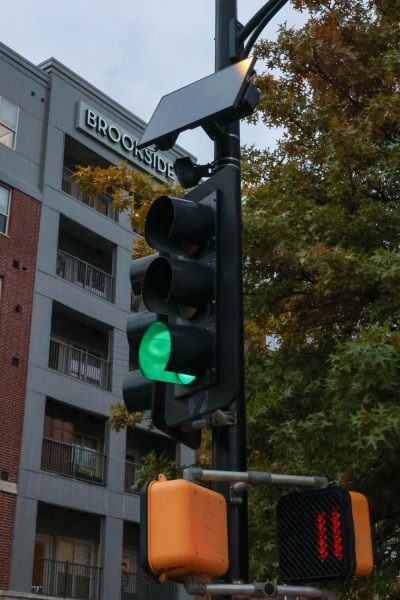
Despite the Columbia Police Department’s frequent use of the automated license plate reader system, the portal fails to provide the police beats and wards where automated license plate reader cameras are located. This is one of the few requirements explicitly stated in the policy and the main failure of compliance.
The Oct. 7, 2024, city council meeting minutes included a planned map of the wards for the placement of Flock cameras. The map does not reflect the current placement of Flock cameras required by Policy 460, nor the beats where they are in.
Policy 460 also requires the Investigations Assistant Chief, now Lance Bolinger, to maintain the portal and include up-to-date and accurate information. Assistant Chief Bolinger did not respond for comment on maintaining training requirements for those authorized to search data collected by Flock devices.
Besides an overview of CPD’s usage, the transparency portal also provides a public search audit that records officers’ reasons for accessing data captured by Flock’s automated license plate readers. Policy 460 regulates how officers describe their use, prohibiting them from using single word entries.
From Aug. 7 to Sep. 5, 93 searches were described with one-word terms — including strings of numbers or symbols — representing 15.5% of all entries during this period. Some entries violating the policy would describe their reason for searching stored information with words like “fleeing,” “warrant” or “law.”
In other instances, entries were labeled with a single asterisk or an unclear acronym, rendering their meaning inaccessible to the general public.
In the following period, from Sep. 5 to Oct. 4, there was about a 9 percentage point drop in one-word descriptions.
The CPD Public Affairs office did not respond for comment on the installation of Flock automated license plate readers and officer training.
Private citizens have documented some of the cameras on the DeFlock automated license plate reader map. DeFlock is a project that wants to “shine a light on the widespread use of ALPR technology, raise awareness about the threats it poses to personal privacy and civil liberties, and empower the public to take action.”
Of the 85 automated license plate readers currently in use, 53 have been documented in Columbia on DeFlock as of Nov. 3. This map underreports cameras around the University of Missouri campus.
Nationwide, reporters with 404 Media found that U.S. immigration authorities have accessed data captured by Flock Safety devices to locate and detain immigrants and U.S. citizens. Concerns about Flock technology’s possible violation of the Fourth Amendment’s clause against unreasonable search and seizure have also been brought to court by the Institute for Justice.
Community members interested in adding to the map can via Deflock’s website after completing a presentation that helps identify automated license plate reader cameras.