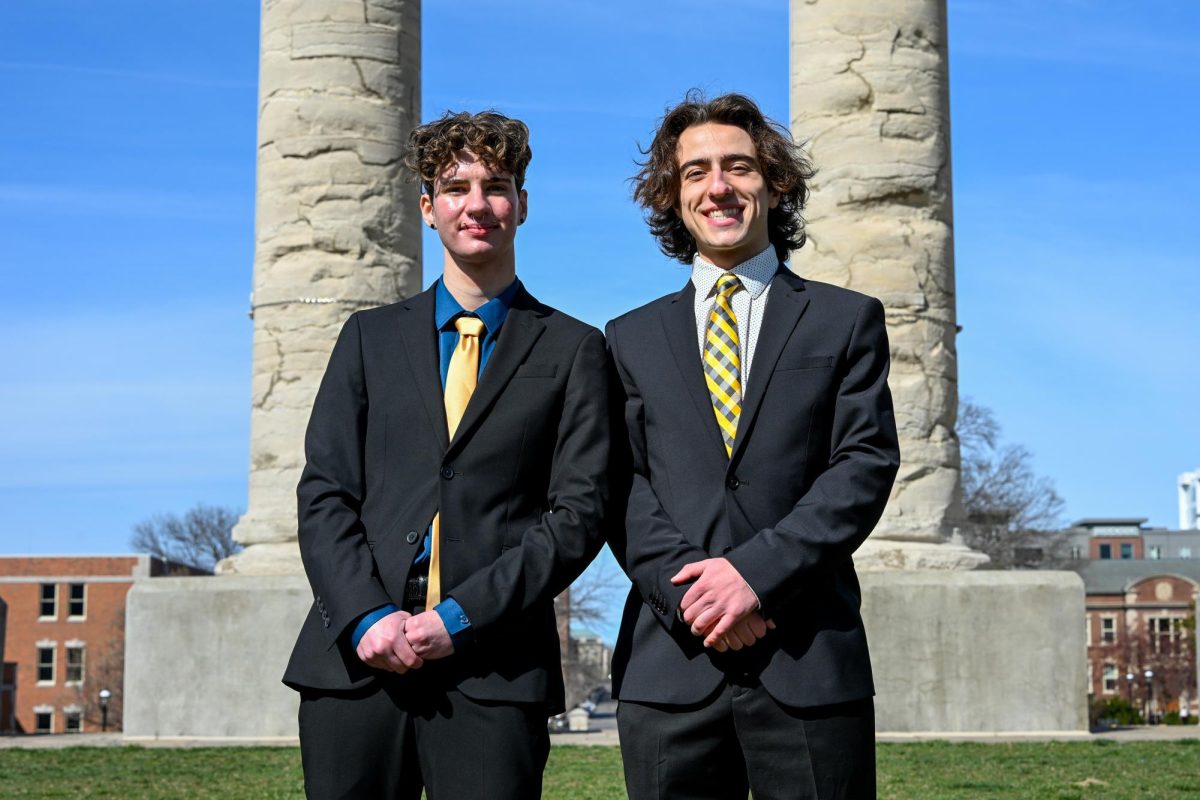
With two campaigns running to lead the Missouri Students Association for the 2026-2027 school year, the members behind the Caring For Our Claws campaign outline their main goals as they run for office.
Juniors Noah Schnarre and Jase DeCota make up the campaign, hoping to be president and vice president, respectively.
Stop Day stays
One major priority for the Schnarre and DeCota campaign is to keep Stop Day as a non-attendance day for students.
Stop Day, recognized as Reading Day by the University of Missouri, was canceled for the Fall 2026 semester, as the school now observes Veterans Day as a national holiday and therefore needed an extra day for instruction.
“That just kind of seems like a lazy slap in the face from admin to just take away one of our students’ big events and holidays that allow us to have kind of a rest or an extra day to study before the end of the semester and before exam week,” Schnarre said.
To accomplish their goal, Schnarre said he and DeCota will meet with Mizzou administration to advocate for students.
“My job as being an elected representative of the student body is to say what the student body wants,” Schnarre said.
Reduce residence hall overcrowding
Schnarre and DeCota agree that the requirement for first-years to live in residence halls should be waived. Instead, they believe first-year students should be able to live in apartments that may be cheaper and more cost-effective.
“I struggled financially a lot more in the dorms than I did moving to an apartment because I didn’t have a kitchen, because I couldn’t store a lot of food, because I was paying these outrageous prices for this little closet,” Schnarre said.
DeCota commented on the struggles he’s seen first-year students have in residence halls, like students being packed into rooms like sardines and living in spaces that weren’t designed as housing.
“They’re taking away study rooms,” DeCota said. “I had less spots to privately study and get away from my roommate for a little bit.”
The slate said they understand there is already some overcrowding in apartments, but incoming first-year students would be signing their lease later than a typical Mizzou student would, so there wouldn’t be any worry of less access to apartments for upperclassmen.
Although new residence halls are being built, Schnarre worried that they won’t be enough to accommodate Mizzou’s recent increase in first-year students.
Schnarre said if their goal is successful, they would advertise the change through the university’s housing portals so that incoming first-year students would know about their different housing options.
Late-night food options
Schnarre and DeCota have seen students at the Student Center around 9:30-10 p.m. studying for upcoming exams. However, all the restaurants around them are closed, leaving these students with no quick food options.
Their solution would be to purchase frozen dinner vending machines that will be accessible with a campus dining plan, so students can still have dining options later at night.
“It’s not going to be like top amazing food,” Schnarre said. “But it is something that students don’t have to go off-campus, if they can’t potentially get a ride or afford non-Dining Dollar food.”
They hope to place the vending machines in common, accessible spaces, like the Student Center, Ellis Library or residence hall lounge areas.
Safer student body
In the past, when there have been safety issues on or around campus, policing efforts have increased. Instead of continuing this trend, the slate plans to raise awareness surrounding safety issues and increase the use of other resources besides law enforcement.
“If you actually really care about the student body, you need to give them the tools to be safe,” Schnarre said. “Just throwing, again, surveillance is just gonna do very little in terms of what’s visible. You’ve got to give students their own visibility in the sense of, they’re able to notice things or say something, or able to control their environments.”
Schnarre and DeCota plan to increase access to emergency lines, public transport, the STRIPES program and specific phone numbers that students can call in certain situations. Overall, they hope to get information about what to do in dangerous situations into the hands of students.
Better athletic tickets
At the start of last fall, the athletics ticketing system changed to a lottery. Previously, students had access to tickets for every game they wanted to attend with the purchase of a Zou Pass.
The platform aims to either revert the system to the previous claiming process or find an entirely new system. However, if this is not possible, Schnarre and DeCota plan to make sure the student body has a better understanding of how the lottery system works.
“Making sure (students) understand that they deserve a right to get what they paid for, and that having this visibility is great for athletics to show that there is a student body that is behind their work and their teams,” Schnarre said. ”It’s important that we care most and foremost about those students that are paying here to be here and paying those tickets to be at these games and show support for our teams.”
Regardless of what the system looks like next year, Schnarre and DeCota aim to have a plan that’ll make student passes cheaper.
Freedom of expression for students
During this school year, multiple identity-based organizations were either defunded or told they could not hold certain events with race included in the title.
“I don’t understand why we’re censoring people like this,” DeCota said. “It doesn’t make any sense to me. They deserve a spot to express themselves, express their culture, and I don’t want them to be defunded or canceled just because they’re doing that.”
The slate understands there could be backlash from university officials, but they are willing to make changes anyway and find ways to work around those issues.
“We have to communicate this to admin in some way,” DeCota said. “Like, be respectful and like, but be honest about it. Like, this is not something we’re okay with. It’s not something a student body is okay with. Like, this is something we need to fix.”
During election week, MSA will host multiple events to encourage voting and inform voters about the various platforms.
- March 16, 6:00-7:00 p.m., Wrench Auditorium – Presidential Debate
- March 17, 9:30-11:30 a.m., Student Center – Pancakes at the Polls
- March 17-19 – Voting Period on MU Engage or Onsite Polling
- March 18, 11:00-1:00 p.m., Student Center – Pop Out to Vote
- March 19, 9:00-11:00 a.m., Student Center – Donuts for Democracy
- March 20, 4:00-5:00 p.m., The Shack – Election Announcements
To learn more about the candidates, read The Maneater’s profile of their slate here.