


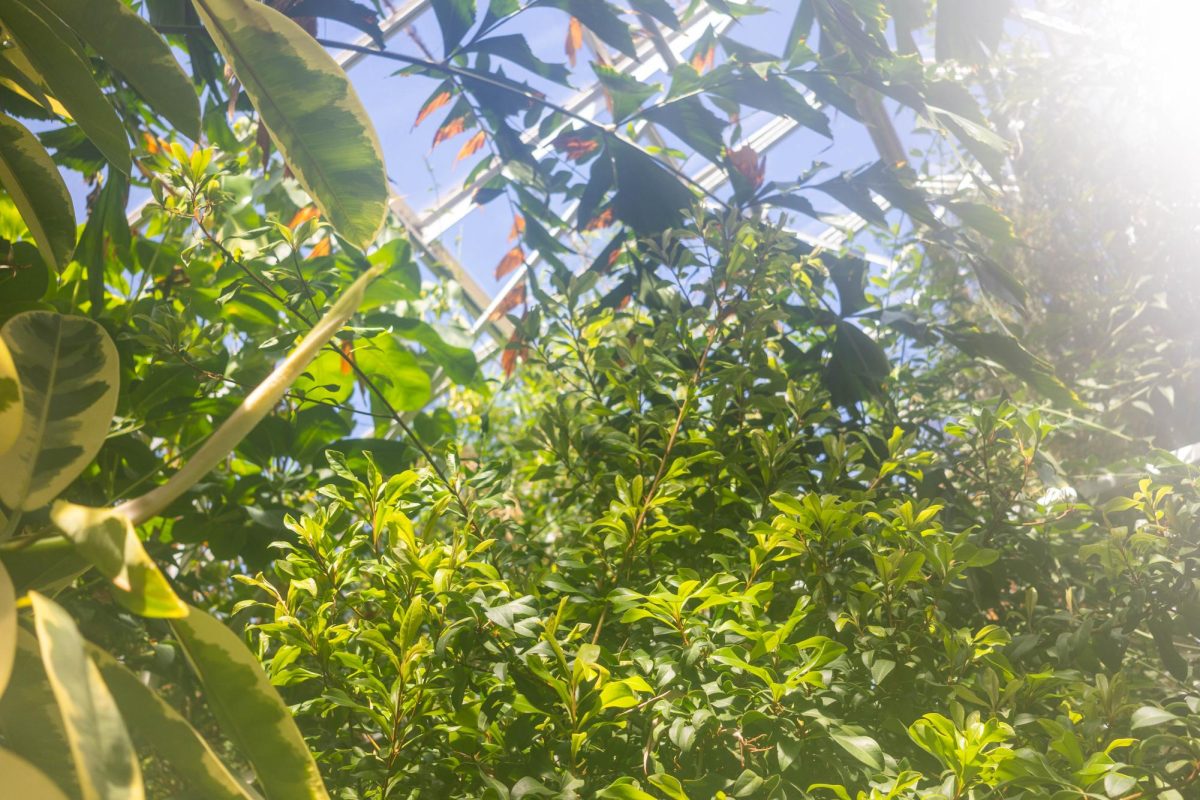
Imagine if there was a place where you could step one foot in a rainforest and the other in a desert. One where you could inhale the smell of dirt and feel the warmth of the sun on your skin, even in the middle of winter. The University of Missouri’s Tucker Hall Greenhouse provides a realm where plants thrive year-round.
Beginnings & history

The greenhouse, founded in 1975, has a unique layout that consists of a tropical rainforest room, a desert room and a mesic room. Founder David Baxter Dunn was a plant taxonomist and curated the greenhouse collections for his students.
“He made these different rooms for students who couldn’t travel,” greenhouse coordinator Kate Chaumont said. “They could still get an idea of what it would look like in its native habitat and get hands-on experience with the plant.”
A portion of the plants in the greenhouse, many of which are well over 50 years old, come from across the globe thanks to Dunn. Now, the greenhouse has an established place as an integral part of Mizzou’s scientific history.

A learning environment
Along with the infrastructure, its purpose has remained the same since its creation: education. Chaumont leads tours for a wide array of ages, ranging from preschool through university students.
Chaumont aims to make the greenhouse a place of escape for the Columbia community.
“The whole point was for people to be able to enjoy it,” Chaumont said. “So however way I can facilitate that for people – leading a tour, letting them sit if they don’t want to talk, that’s perfectly fine too.”
Power of plants
Experiencing the greenhouse also teaches a lesson more innate than just plant anatomy: the importance of staying grounded.
“Without constant demands for my attention, the plants have been here for 50 years,” Chaumont said. “They will hopefully be here another 50 (years). They aren’t going anywhere, they aren’t in a hurry to do anything, and I think that’s a very good lesson for me.”
Senior Kenny Henk, the greenhouse manager of Mizzou’s Horticulture Club, has been volunteering in the greenhouse since 2022. Spending time there has created the same mentality for Henk.
“I feel like being able to work with these plants, they do wonders for my mental health,” Henk said. “Because they’re fun, they’re green, they’re funky, they do cool things, they make fun flowers sometimes and they’re just fascinating to me.”
Closeness to the natural world seemingly creates a feel-good environment for students. Horticulture Club Treasurer Anna Heiple is majoring in animal science and biological sciences, and attests that her connection with nature has been a great help when dealing with academic stress.
“It helps me stay in the moment,” Heiple said. “I am very much, like, in my head a lot — worrying about the future, getting anxious over the past — and it kind of just helps me stay right where I’m supposed to be.”
Henk believes that coming to the greenhouse to connect with plants can be a tool to stay grounded.
“It’s good to get out of your head, especially in the heat of the semester, right? And just go and do something that doesn’t take a whole lot of brain power,” Henk said.

The science
This pattern of plants making people feel good can actually be scientifically explained.
“There is something in the chemicals that are released by plants that interact with our biochemistry to create a very different experience than what we get when we’re indoors, for example, or away from plants,” Botany professor Bethany Stone said. “And so there is a physiological response to being around plants.”
That physiological response makes the greenhouse beneficial to students.
“I think you do appreciate plants when you go down to that Tucker Greenhouse, because you get to see them in a very small space,” Stone said. “You get to see all their forms and the diversity in which plants come.”
Tucker Hall Greenhouse is open Monday through Friday from 8:30 a.m. to 4:30 p.m., and students can enter through the door inside the lower level of Tucker Hall. Henk says the greenhouse is open to all students, no permission needed.
“It can be a bit intimidating because oftentimes it is empty, but I think that just adds to the experience,” Henk said. “You have the space largely to yourself to just take it all in.”

